Concrete Retaining Walls in Hickory, NC
Poured concrete and segmental block retaining walls across the NC Foothills — controlling erosion, managing runoff, and turning steep, unusable slopes into level, functional yard space.
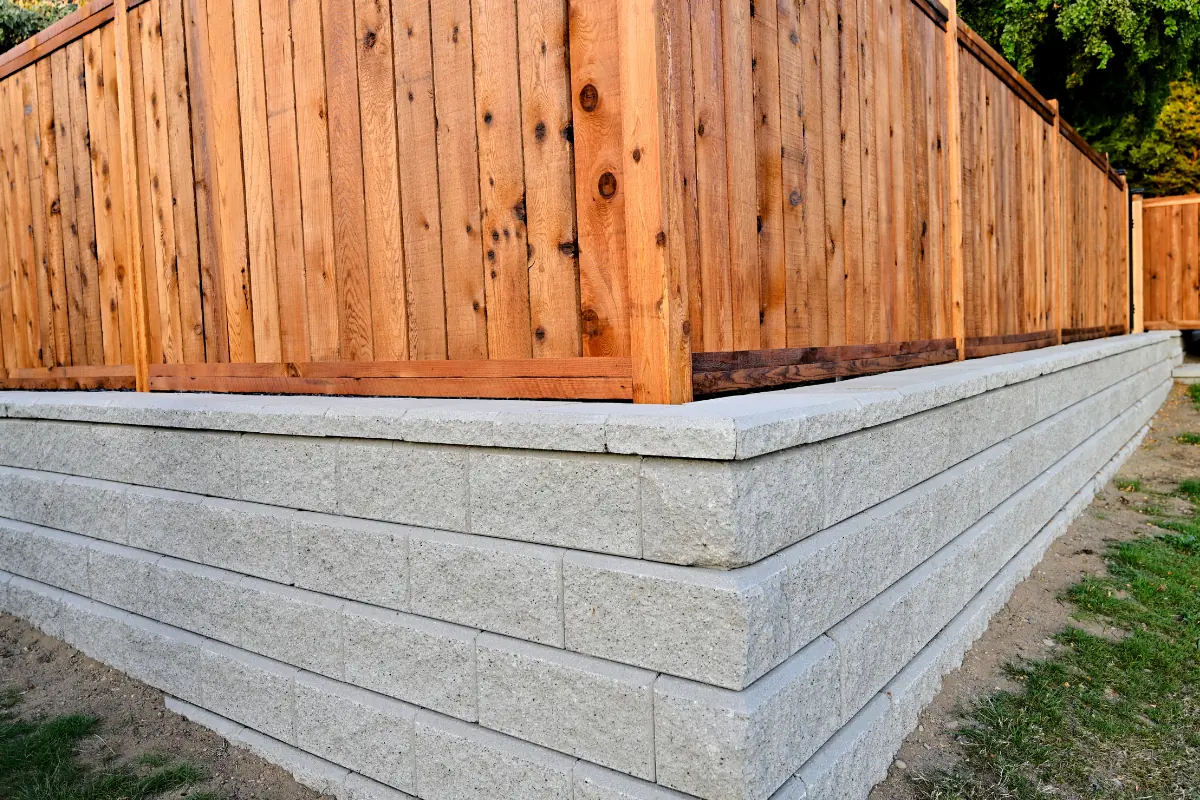
Retaining Walls for Foothills Terrain
If you live in the Foothills, there's a good chance your property has a slope — and slopes mean erosion, runoff, and yard space you can't really use. A well-built retaining wall solves all three. The Foothills Concrete Company designs and builds retaining walls throughout Hickory and the surrounding counties, engineered for our hilly terrain and clay soils.
Wall Types We Build
- Segmental block walls — engineered interlocking concrete blocks, ideal for most residential walls and available in several colors and textures.
- Poured concrete walls — maximum strength for taller walls and heavy-load situations.
- Tiered & terraced walls — multiple shorter walls that turn a steep slope into usable planting or living levels.
- Erosion-control walls — stop a hillside from washing into your yard, driveway, or foundation.
- Garden & seating walls — lower decorative walls that define and elevate a landscape.
Drainage Is Everything
The number one reason retaining walls fail isn't the blocks — it's water. Soil saturated with water becomes incredibly heavy, and that pressure behind a wall is what pushes it out, cracks it, and topples it. We engineer drainage into every wall we build: proper gravel backfill, drain pipe where needed, and grading that moves water away. In the Foothills' clay soils, which hold water and freeze, that drainage work is the difference between a wall that lasts a generation and one that bulges in a few years.
Choosing a Retaining Wall Builder in Hickory, NC
A retaining wall builder is doing structural work, not landscaping — the wall is holding a mass of saturated soil in place, and what decides whether it lasts is the base, the drainage and the batter, none of which you can see once the job is finished. That is why we walk you through the buildup before we quote it.
We build poured concrete and segmental block retaining walls across Hickory, Conover, Newton, Lenoir, Morganton and the rest of the Foothills, and we engineer drainage into every one. Here is the sequence.
How We Build a Retaining Wall
1. Assess the load and the water
Before anything is priced we look at what the wall has to hold: the height, the slope above it, whether anything is surcharging it from behind such as a driveway or a structure, and where the water goes. Height and surcharge decide the wall type. Water decides whether it survives.
2. Excavate and build the base
We excavate below grade and build a compacted stone leveling pad. The first course sets the accuracy of everything above it, so it is worth the time. On taller walls the base is buried deeper, roughly a tenth of the wall height as a rule of thumb.
3. Drainage — the part that decides everything
Behind every wall we build goes clean drainage stone and a perforated drain line daylighted to somewhere sensible. Water is the reason walls fail. Saturated soil behind a wall exerts hydrostatic pressure that no amount of block weight resists, and a wall built without drainage is a wall on a countdown regardless of how good it looks the week it goes in.
4. Build, batter, backfill and cap
Courses are set with a slight backward lean into the hill, and we backfill and compact in lifts as the wall rises rather than all at once at the end. Geogrid is added where the height and load call for it. Caps are set and secured last.
Poured Concrete or Segmental Block?
Segmental block is the right answer for most residential walls. It is flexible enough to tolerate minor ground movement, comes in a range of faces and colours, builds fast, and handles curves and tiers well.
Poured concrete makes sense for a rigid engineered wall, tight spaces, unusual geometry, or where a wall is doing structural work as part of a foundation or a driveway edge. It costs more and needs forming, but it is the stronger option where the situation calls for it.
We will tell you which one your site actually needs. On a typical Foothills hillside lot with a wall under four feet, block is usually both cheaper and better.
Why Retaining Walls Fail
No drainage. The single most common cause, by a wide margin. Water builds up behind the wall and pushes it out.
No base, or a base that was never compacted. The wall settles unevenly and the courses open up.
Too tall for the type. Above about four feet, and lower where there is surcharge above, a wall needs engineering and often geogrid reinforcement into the hillside. Stacking block higher and hoping is how walls lean.
Backfilled with the soil that came out. Clay backfill holds water against the wall. Clean stone is what belongs there.
The Foothills Way vs. The Other Guys
Not all concrete work is the same. Here's how we approach a retaining wall construction compared to the cut-corner crews that leave homeowners with cracked, failing concrete a few winters later.
| What Matters | The Foothills Concrete Company | The Other Guys |
|---|---|---|
| Base preparation | Properly excavated & compacted gravel base | Pour over loose or uneven dirt |
| Thickness & reinforcement | Poured to load with rebar or wire mesh | Thin pours, skipped reinforcement |
| Drainage & slope | Graded to move water away | Water pools & undermines the slab |
| Control joints | Cut at proper spacing to control cracking | Too few or none — random cracks |
| Pricing | Written, transparent, no surprises | Vague quotes, add-ons at the end |
| Accountability | Local, licensed, insured & here to stay | Out-of-town, hard to reach later |
Our Concrete Confidence Package
Every project we take on comes with the same commitment — what we call our Concrete Confidence Package. It's our promise that you'll know exactly what to expect before we ever break ground:
- Clear expectations up front — a written scope of work, finish options, and timeline before we start, so there are no surprises.
- Locked-in pricing — the number on your written estimate is the number you pay. No mid-project add-ons.
- Workmanship you can count on — we stand behind every pour and back our work, because our name and reputation in the Foothills depend on it.
- Honest, faith-driven service — as a Christian-owned company, we treat your property and your budget with respect from the first call to the final walkthrough.
Frequently Asked Questions
Ask how the wall drains, what the base is built on, and how much batter it will have. A retaining wall builder who cannot answer those three plainly is quoting a stack of block, not a structure. Also confirm the wall is being built to the height and load your site actually needs — walls fail from water and undersized base far more often than from the block itself.
Many areas require a permit and engineering for walls above a certain height (often around 4 feet). We're familiar with local requirements across the Foothills counties and will let you know what your specific wall needs.
The most common cause is poor drainage — water builds up behind the wall, and the soil pressure pushes it out or cracks it. We build proper drainage into every wall, which is the single most important factor in a wall that lasts.
Absolutely. Tiered or terraced retaining walls are one of the best ways to turn a steep, unusable Foothills slope into level areas you can actually use for lawn, gardens, patios, or play space.
Walls are priced per face foot — the height multiplied by the length of the visible face — rather than per square foot of ground. The number depends heavily on height, wall type, how much excavation is needed, whether geogrid is required, and access for equipment. Because drainage and site conditions drive the price so much, we quote walls on site, and that visit is free.
As a general rule, walls up to about four feet can be built to standard specification, and above that engineering is normally required. Local requirements vary across the counties we serve, and a wall of any height with a driveway, pool or structure above it may need engineering regardless. We will tell you plainly which category your project falls into.
Yes, always. Drainage stone and a perforated drain line behind the wall are not an upgrade, they are the wall. Hydrostatic pressure from saturated soil is the most common reason walls fail, and it is entirely preventable at build time.
Often yes, and on a long Foothills slope tiering can look better and cost less than a single tall engineered wall. Tiers have to be spaced far enough apart that the upper wall is not surcharging the lower one, which is a design question we work through on site.
Walls are the one part of our work that is closer to concrete construction than to flatwork, because a wall is holding a load rather than carrying one, and the engineering matters more than the finish.
Retaining Walls by Town
Every town we serve brings its own ground conditions. These pages cover what changes locally:
Explore Our Other Concrete Services
We build retaining walls across the Foothills, and the terrain changes a lot from town to town — the hillside lots in Lenoir, Morganton, and Icard are where a wall most often turns unusable slope into level, usable yard. As a Hickory concrete contractor we cover all six Foothills counties.
We handle every kind of residential and commercial concrete across the Foothills. A few related services: